Pizzeria Dough and Cheese Yield Tracking: Find the Money You're Losing by Ounce
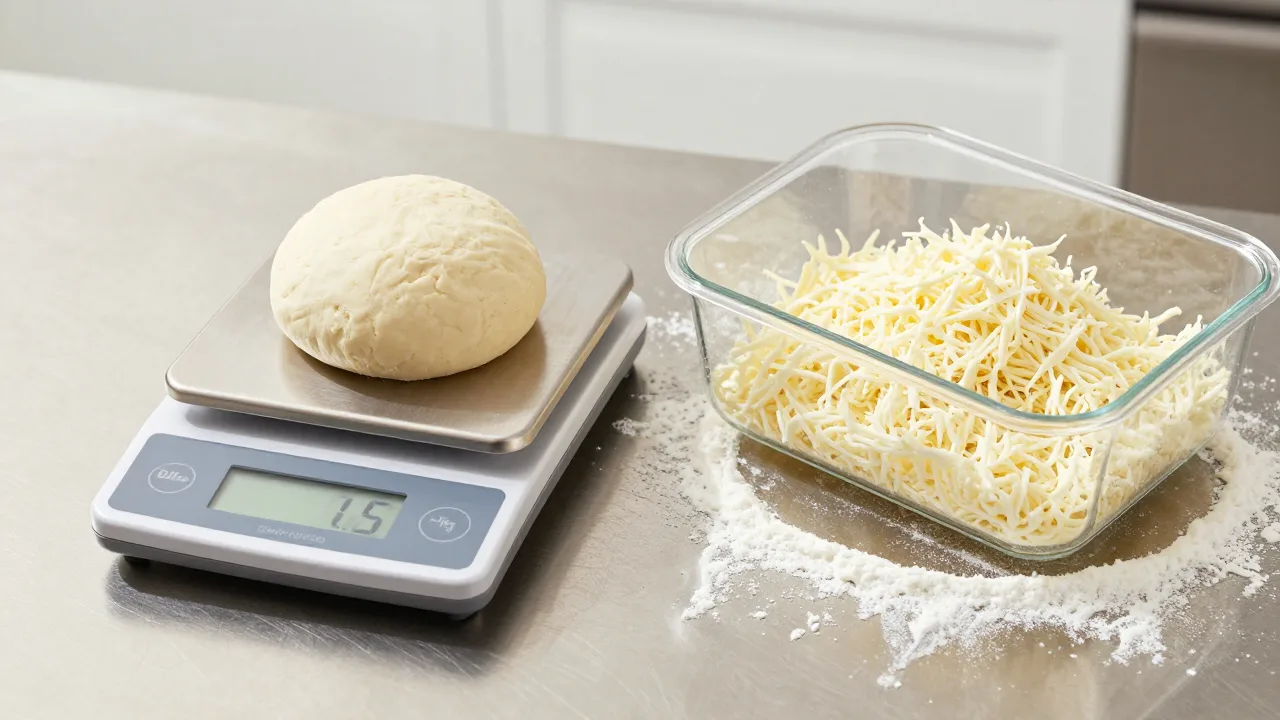
Try this before you read any further. Pull ten dough balls at random out of tonight's rack and weigh them one at a time. Write the numbers down. In most pizzerias I've seen do this exercise, the spread between the lightest and the heaviest ball is somewhere between 1.5 and 3 ounces — on a product that's supposed to be identical ten times over.
Then do the same with cheese. Have three different people build a 14-inch pepperoni the way they normally do, and weigh the cheese before it goes on. The spread there is usually wider, because cheese is portioned by handful and handfuls are personal.
Here's the problem in one sentence: dough and cheese together typically account for 55 to 70 percent of a pizzeria's food cost, and both are portioned by feel on a busy line where nobody has time to feel carefully.
Why This Leak Never Shows Up in Your Reports
Now let's make it uncomfortable. A food-cost percentage — the number most operators check monthly — cannot detect over-portioning. It can only detect that something is wrong. If your cost of goods runs 31% instead of the 28% you budgeted, that three-point gap could be a supplier price increase, a mix shift toward cheese-heavy specialty pies, waste, comps, theft, or the fact that your Thursday closer builds every pizza like it's for his own family. The percentage tells you the house is on fire. It does not tell you which room.
Meanwhile the arithmetic runs against you every single shift. Take a shop doing $900,000 a year with a 29% food cost. That's roughly $261,000 in ingredients. If cheese is 30% of that spend — about $78,000 — then a 6% over-portion on cheese alone is $4,700 walking out the door annually. Add a similar drift on dough and you are past $7,000, which for many independents is most of a month's profit.
What makes it worse: over-portioning is invisible by design. Nobody complains about too much cheese. Customers like it. Staff feel generous. There is no incident report, no ticket, no angry review. The only place it exists is in a variance number that most pizzerias never calculate.
And the drift is almost always upward. Portions creep heavier over time because a light pizza generates a complaint and a heavy one generates a compliment. Left alone, a line will slowly redefine your recipe for you.
The Fix: Theoretical vs Actual, Weekly
The solution is a single comparison run on a short cycle. Theoretical usage is what your recipes say you consumed, calculated automatically from what your POS rang up. Actual usage is what really left the building, calculated the old-fashioned way from a count. The difference is variance, and variance is the number worth building a routine around.
The formula is not complicated:
- Actual usage = opening inventory + purchases − closing inventory
- Theoretical usage = Σ (units sold × recipe quantity per unit)
- Variance = (actual − theoretical) ÷ theoretical × 100
A well-run pizzeria holds cheese variance under 3% and dough variance under 2%. Anything above 5% on either is not a rounding error — it is a specific behavior happening on specific shifts, and it is findable.
The part your POS makes possible is the theoretical side. Once each menu item carries a recipe — 7 ounces of mozzarella on the 14-inch, one 14-ounce dough ball, 4 ounces of sauce — the system multiplies by sales automatically and hands you the number. You never calculate it by hand. Your only job is the weekly count. If you want to sanity-check your per-item costs before you build the recipes, run them through a food cost calculator that breaks each menu item into ingredient-level cost — five minutes there prevents a month of chasing the wrong number.
Setting Dough Standards That Actually Hold
Write the spec by size, in ounces
Every size gets one number, posted where the dough is scaled. Typical starting points for a standard American-style crust:
| Size | Dough ball spec | Cheese spec | Sauce spec |
|---|---|---|---|
| 10″ small | 8–9 oz | 3.5–4 oz | 2.5 oz |
| 12″ medium | 11–12 oz | 4.5–5 oz | 3 oz |
| 14″ large | 14–15 oz | 6.5–7.5 oz | 4 oz |
| 18″ extra large | 22–24 oz | 9–11 oz | 6 oz |
| Sicilian half sheet | 32–36 oz | 14–16 oz | 10 oz |
These are starting points, not gospel — a thin New York style and a pan style will diverge sharply. What matters is that your number is written down and repeatable.
Scale on the way in, not on the way out
Dough gets weighed at ball-up, when the mixer is running and the pace is calm. Trying to control dough weight at the bench during a Friday rush does not work and never has. A digital scale at the dough table and a two-week habit will cut your dough variance more than any software will.
Track waste as a line item
Dough that over-proofs, gets torn, or hits the floor is not variance — it's waste, and it deserves its own log. Separating the two matters: waste points at production planning, variance points at portioning. A pizzeria throwing 40 balls a week is telling you its par levels are wrong, not that its cooks are heavy-handed. Our deeper walkthrough of cutting inventory waste with your POS covers the logging side in detail.
Getting Cheese Under Control Without Slowing the Line
Cheese is harder than dough because it is portioned during the rush, by hand, on a build that takes eleven seconds. Anything that adds five seconds per pizza will be abandoned by Friday. So the controls have to be physical, not procedural.
Portion cups beat scales at the bench. Find the deli cup or scoop that holds your spec weight of your specific shred, and standardize on it. One level cup, one pizza. Cooks can do this at full speed; they cannot weigh at full speed.
Calibrate the cup weekly. Shred size, moisture, and supplier changes all shift volume-to-weight. A cup that held 7 ounces in March may hold 7.9 in August with a different shred. Weigh the cup's contents every Monday and adjust if it drifted.
Handle half-and-half deliberately. Split pies are the most common source of quiet cheese overage, because each half tends to get built like its own pizza. The rule should be explicit: one full portion split across two halves, not two half portions eyeballed.
Ring in every staff meal and comp. Free food that never touches the POS lands entirely in your variance number and makes it look like theft. If a shift meal isn't rung in at zero price, you are corrupting the only signal you have.
Check the mix, not just the total. A month where specialty pies outsold plain ones will show higher cheese usage without any portioning problem at all. Good POS reporting and analytics lets you separate mix shift from behavior shift, which is the difference between coaching someone and apologizing to them.
Real Numbers: A 14-Ounce Spec That Was Actually 15.4
Illustrative scenario — a composite example built to show how the numbers work. It does not describe a real business or customer.
A single-location pizzeria in central New Jersey, roughly $840K in annual sales, ran a 30.8% food cost against a 28% target and could not find the gap. The owner assumed supplier pricing. Three weeks of weekly counts on six ingredients told a different story:
- Cheese variance: +9.1% against theoretical — about 46 lb per week unaccounted
- Dough variance: +8.7% — the 14 oz spec was scaling at 15.4 oz average
- Root causes found: no portion cup on the cheese rail (hand-portioned), dough scaled by eye during the morning prep block, and 11 staff pizzas a week never rung in
- After 60 days: cheese variance to +2.4%, dough to +1.6%, food cost 30.8% → 28.4%
- Annualized recovery: roughly $20,100 — from a $19 scale, a $4 deli cup, and a rung-in comp button
No supplier was renegotiated. No prices were raised. The only thing that changed was that somebody started measuring.
Your First 30 Days
- Week 1 — Build recipes for your top 20 items. These will be 80% of your volume. Enter dough, cheese, and sauce quantities per size. Skip the long tail for now.
- Week 1 — Establish a counting routine. Same day, same time, same person, same order. Six items: cheese, flour or dough, sauce, pepperoni, boxes, one protein. Fifteen minutes.
- Week 2 — Take your first variance reading. Do not act on it. One week of data has too much noise. Just record it.
- Week 3 — Take the second reading and compare. If both weeks show the same direction on the same item, that's a real signal.
- Week 3 — Introduce the physical controls. Scale at the dough table, portion cup on the cheese rail, spec card posted at both. Explain the why to the crew: this is about consistency for customers, and it is.
- Week 4 — Read the variance again and coach specifically. "Cheese ran 9% over last month, we're at 3% now, keep the cup level" lands very differently than "we need to watch food cost."
- Ongoing — Review monthly, count weekly. When any item crosses 5% variance two weeks running, investigate that week, not next quarter.
One caution before you start: don't try to track forty ingredients. Operators who attempt full-catalog inventory almost always abandon the routine inside two months, and a lapsed system tells you nothing. Six items counted every week for a year beats forty items counted twice. Once the habit sticks, the broader pizzeria inventory management practices are easy to layer on, and the same weekly-count discipline scales cleanly across the wider restaurant inventory management fundamentals that apply outside pizza too.
The last thing worth saying: yield tracking is not really about catching people. In every shop I've watched run this exercise, the overwhelming majority of the gap turned out to be habit, drift, and untracked comps — not dishonesty. What you're actually buying is a consistent product, which happens to be the same thing that protects your margin. Pull ten dough balls tonight and weigh them. The number will tell you whether you have a project.
Frequently Asked Questions
How much cheese should go on a pizza?
Most independent pizzerias standardize between 4 and 5 ounces of shredded mozzarella on a 12-inch pie, 6 to 8 ounces on a 14-inch, and 8 to 11 ounces on an 18-inch, adjusted for style and how much sauce and topping weight sits underneath. The exact number matters less than picking one, writing it down, and holding the line. A shop that runs a consistent 7 ounces on its 14-inch is in far better financial shape than one that averages 6.5 but swings between 5 and 9 depending on who is working.
What is theoretical vs actual food cost?
Theoretical cost is what your ingredients should have cost given exactly what you sold: every pizza rung up multiplied by its recipe. Actual cost is what you really consumed, calculated as opening inventory plus purchases minus closing inventory. The gap between the two is your variance, and it is the single most useful number in a pizzeria's back office. Variance is where over-portioning, waste, comps, breakage, and theft all show up — and none of them are visible in a plain food-cost percentage.
How often should a pizzeria count dough and cheese?
Count your top five or six cost drivers weekly, not monthly. For most pizzerias that list is cheese, flour or dough balls, pepperoni, sauce, boxes, and one protein. A weekly count on six items takes about fifteen minutes and gives you a variance number tight enough to act on while the cause is still recent. Full monthly counts still have a place for accounting, but a monthly-only cycle means a portioning problem can run for four weeks before anyone sees it.
Why is my cheese usage higher than my recipe says?
In order of frequency: hand-portioning without a scale or a portion cup, free cheese on staff meals and comps that never gets rung in, a shredder or supplier moisture difference that changes volume-to-weight ratios, dropped and re-shredded product, and half-and-half or specialty pies that get two full portions instead of one split portion. Menu items built off-recipe by a new cook usually account for more variance than theft does, which is good news because it is fixable with a scale and one training shift.
Does dough scaling really affect profit that much?
Yes, because it compounds. If your 14-inch dough ball spec is 14 ounces and your bench actually runs 15.2, you are giving away 1.2 ounces per pie. At 180 large pies a week and roughly $0.85 per pound of finished dough cost, that is about $600 a year on one size alone — before the knock-on effects of thicker crusts baking longer, holding less topping, and drifting away from the product customers expect. Dough scaling is the cheapest consistency control in the building.
Turn Every Pizza Into a Recipe the System Tracks
KwickOS ties recipes to sales so theoretical usage calculates itself, flags variance by ingredient and by location, and turns your weekly count into a report you can coach from. Use KwickOS to stop guessing where the cheese went.
Get Started Free →