Pizza Delivery Driver Cash Settlement and Tip-Out: Close the Night in Six Minutes
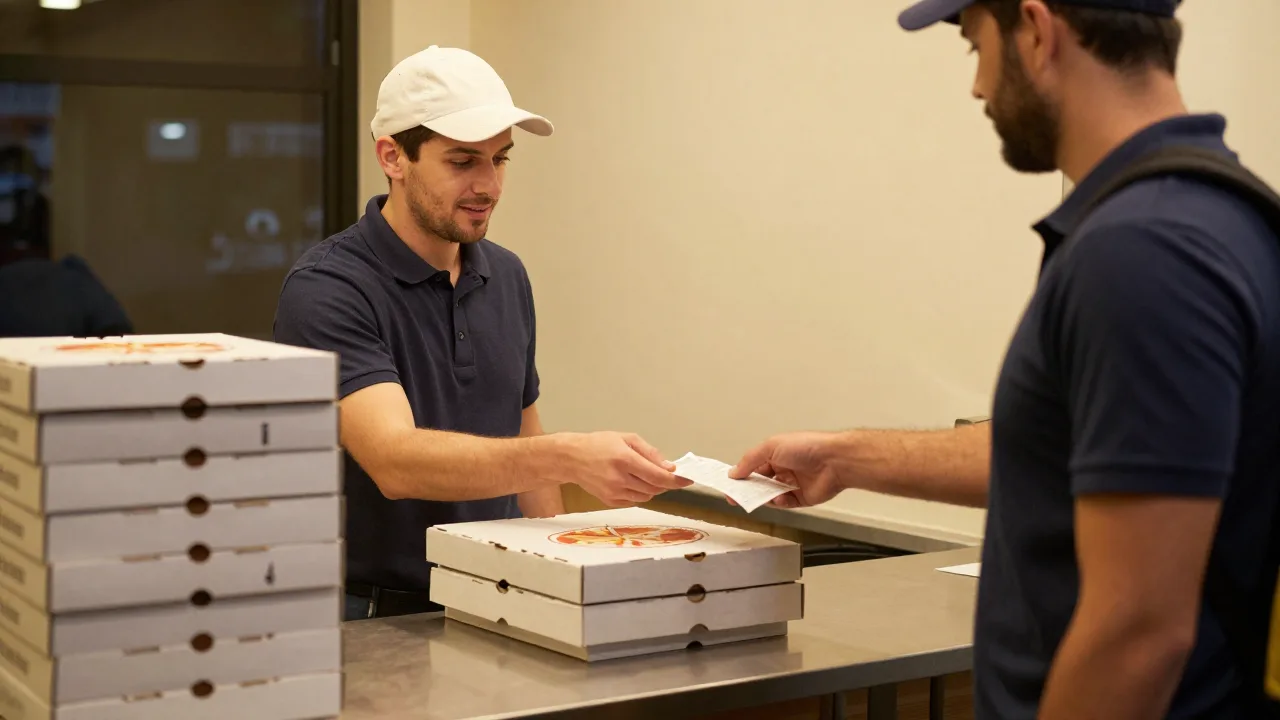
It's 11:47 on a Saturday. Three drivers are back, the ovens are off, and the manager is standing at the counter with a calculator, a rubber-banded stack of receipts, and a $40 bank envelope that started the night with $40 in it and now contains $37 and a gum wrapper. One driver thinks he did nine runs; the report says eleven. Another has a card slip with a tip written in a hand nobody can read. Somewhere in this pile is the answer to a simple question — who owes whom, and how much? — and it will take thirty-five minutes to find.
That's the problem. Delivery settlement is the last unautomated task in most pizzerias, and it's the one that happens when everybody is tired.
Why Settlement Goes Wrong
Let's be honest about what's actually at stake, because "closing takes too long" undersells it.
First, the labor cost is real and recurring. Thirty-five minutes of manager time per night, six nights a week, is about 180 hours a year — roughly $4,000 in wages spent on arithmetic, and it's the most expensive hour of the day because it's overtime-adjacent and it delays lockup.
Second, the errors are asymmetric. When settlement is reconstructed from memory and receipts, small discrepancies get waved off. "You're four dollars short, don't worry about it" is a reasonable thing to say once. Said four nights a week across three drivers, it's $2,500 a year that nobody ever decided to spend.
Third — and this is the one that actually keeps operators up — sloppy settlement makes real problems invisible. If your cash variance is routinely $5 to $15 and nobody knows why, then a genuine $60 problem hides comfortably inside the noise. You cannot detect a pattern in a process that never produces a clean number.
Fourth, tips and fees are a compliance surface. Delivery fees, driver tips, mileage reimbursement, and tip-out to the inside crew are four different categories of money with four different treatments, and a settlement process that mixes them in a single mental subtraction is the kind of thing that becomes expensive during a wage audit. (Rules here vary by state and change; treat everything below as operational structure, and have a labor attorney review your specific arrangement.)
The Five Buckets Every Settlement Touches
Before automating anything, get the categories straight. Every dollar in a driver's hand at midnight belongs to exactly one of these:
| Bucket | Whose money | Where it lands |
|---|---|---|
| Order subtotal + tax | The restaurant | Back to the drawer |
| Delivery fee | The restaurant (unless you pass it through) | Revenue line, disclosed to customer |
| Customer tip | The driver | Driver keeps; reported as wages |
| Mileage reimbursement | The driver | Paid out or added to payroll |
| Tip-out | Inside crew | Deducted from driver, distributed per policy |
Here's the trap worth naming: the delivery fee and the tip are the two most frequently confused, and confusing them causes both customer complaints and legal exposure. If a customer sees a $3.99 delivery fee, many assume the driver received it. If the driver did not, the disclosure needs to be explicit at the point of order, and the two amounts must live as separate line items in the POS so they never merge in a report.
The Settlement Math, Written Once
The whole calculation fits on one line, and the point of writing it out is that your POS should be doing every term of it:
Driver owes drawer = (cash orders collected) − (starting bank) − (mileage reimbursement) + (tip-out owed) − (card tips paid out in cash)
Work an example. A driver takes a $40 bank, runs 12 deliveries, of which 7 were paid cash totaling $214.60 including tips, and 5 were prepaid by card with $23 in card tips. The shop pays $1.50 per run in mileage and takes a 2% tip-out on delivery sales of $486.
- Cash collected: $214.60
- Less starting bank returned separately: bank comes back intact, so it isn't in this number
- Less mileage: 12 × $1.50 = $18.00
- Less card tips paid out in cash: $23.00
- Plus tip-out owed by driver: 2% × $486 = $9.72
- Cash tips inside the $214.60 that belong to the driver: $31.40
Net: the driver hands back $214.60 − $31.40 (their cash tips) − $18.00 (mileage) − $23.00 (card tips due to them) + $9.72 (tip-out) = $151.92, plus the $40 bank. Two numbers, one count, done.
Nobody should be computing that by hand at midnight. Every input — orders assigned, payment type, tip amount, run count — already exists inside the POS the moment each order is dispatched. If your close involves re-entering any of it, the problem is upstream. If you want to model different tip-out structures before committing to one, a tip split calculator that lets you test percentages against real shift numbers is a faster way to find out what a policy actually costs your drivers than announcing it and finding out from them.
Assign at Dispatch, Not at Close
This is the single change that collapses forty minutes into six, and it costs nothing.
Most settlement pain comes from reconstruction. If orders are attached to drivers at the end of the night — by matching receipts, by memory, by asking — then every close is a small forensic exercise. If instead the dispatcher taps a driver name when the order leaves the building, the report is already complete before anyone walks back in.
What assignment-at-dispatch gives you beyond speed:
- Out-the-door timestamps, which is the only honest way to measure delivery time and the foundation of any useful delivery tracking setup.
- Run counts per driver, so mileage is calculated rather than negotiated.
- Load balancing — you can see that one driver has four orders stacked while another is idle, which is worth more on a Friday than any settlement improvement.
- An audit trail, so a customer calling about a missing order has a name and a time attached to it.
The dispatch discipline pairs directly with how you draw your zones; a driver carrying three orders across two zones is a settlement problem and a service problem at once. Our breakdown of delivery zone optimization covers where those boundaries should sit.
Handling Card Tips Without Draining the Drawer
Card tips are where cash management and driver preference collide. Drivers overwhelmingly want their card tips in cash the same night. That's understandable — and it means your drawer is funding tips it hasn't been reimbursed for until the batch settles.
On a busy Saturday, three drivers with $25 to $40 in card tips each can pull $100+ out of the drawer before the deposit is even counted. Shops that don't plan for this end up short on change by Sunday afternoon and start pulling from the safe, which breaks the one clean number they had.
Two workable approaches. Pay card tips nightly but size your opening bank to absorb it — add the historical average card-tip payout to your daily starting cash and treat it as working capital, not profit. Or accumulate card tips to the paycheck, which is cleaner but requires an honest conversation with your crew before you change it, not after. Either way the tip amount must be captured per driver in the POS and flow to payroll as reported wages. The broader tradeoffs of running a cash-heavy versus card-heavy delivery operation are laid out well in this comparison of cash versus card payment handling for restaurants, and the mechanics of tip capture at the terminal are covered in our guide to pizza POS payment processing.
Real Numbers: Three Drivers, Thirty-Eight Minutes Back
Illustrative scenario — a composite example built to show how the numbers work. It does not describe a real business or customer.
A delivery-heavy pizzeria in the Chicago suburbs — roughly 68% of sales going out the door, four drivers on weekends — was closing at 12:35 a.m. on a kitchen that shut at 11. The owner tracked eight weeks before and after switching to dispatch-time driver assignment with an automated settlement report:
- Average close time: 38 min → 7 min across all drivers
- Nightly cash variance: ±$11.40 average → ±$1.60 average
- Unexplained shortages over 8 weeks: $412 → $61
- Manager labor recovered: ~2.6 hours/week, about $3,100/year
- Driver disputes about run counts: weekly → zero (the report shows every timestamp)
The owner's note afterward was that the biggest win wasn't the money. It was that drivers stopped feeling accused, because the number came from the system instead of from an argument.
A Settlement Routine You Can Hand to a Shift Lead
- Issue banks with a signature. Same amount every shift ($40 and $50 are the common ones). Driver signs for it. This takes ten seconds and eliminates the most common source of end-of-night confusion.
- Assign every order at dispatch. No exceptions, including the one the owner ran himself.
- Record tips at the terminal, not on paper. Handwritten tip amounts on slips are a reconciliation tax you pay forever.
- Print the driver settlement report at clock-out. One page: runs, sales by payment type, tips, mileage, tip-out, net owed.
- Count once, together. Driver and manager both present, cash counted against the report's number.
- Log any variance immediately, no matter how small. A $2 discrepancy recorded is data; a $2 discrepancy waved off is noise you'll be hiding behind in six months.
- Distribute the tip-out the same night, per written policy. Same formula every shift, calculated by the system. Nothing corrodes a crew faster than a tip-out that feels improvised.
- Review the weekly rollup on Monday. Variance by driver, runs per hour by driver, average tip by driver. Patterns show up in weeks, never in nights.
Two things to avoid. Don't build a tip-out policy verbally — write it, post it, and have counsel confirm it fits your state's rules and your tip-credit posture, since managers and owners generally cannot share in a tip pool. And don't let drivers settle themselves without a second set of eyes, no matter how long they've worked for you; the point of a two-person count is that it protects the honest ones, who are almost everybody. Pair this with consistent employee management and role permissions and the whole thing runs on rails.
The real prize here isn't seven-minute closes, pleasant as those are. It's that once settlement produces a clean number every night, that number starts telling you things — which driver is doing 2.4 runs an hour versus 1.6, which shift bleeds cash, whether your $3.99 delivery fee is covering what it's supposed to cover. A messy close hides all of that. A clean one hands it to you for free.
Frequently Asked Questions
How does driver cash settlement work in a pizzeria?
The driver starts the shift with a fixed bank of small bills, takes cash orders out, and returns with that cash plus their bank. At settlement, the POS totals every order assigned to that driver, separates cash orders from card orders, subtracts the starting bank and any mileage reimbursement, applies the tip-out, and prints one number: what the driver owes the drawer or what the house owes the driver. Done properly the entire close is a single report and one count, not a stack of receipts and mental math.
Is a delivery fee the same as a driver tip?
No, and conflating the two is one of the most common compliance problems in pizza delivery. A delivery fee is revenue charged by the restaurant; a tip is money the customer intends for the driver. They are treated differently for tax, for wage calculations, and for what you must disclose to customers. If you charge a delivery fee and do not pass all of it to the driver, say so clearly at the point of order, and keep the two amounts as separate line items in your POS so they never blur together in reporting.
Should drivers be paid card tips in cash at the end of the shift?
Many pizzerias do pay card tips out in cash nightly because drivers prefer it, and it is generally permitted as long as the tips are still reported as wages and taxed correctly through payroll. The operational risk is that nightly cash payouts drain your drawer and create a second reconciliation problem. The alternative — accumulating card tips and paying them on the paycheck — is cleaner for cash management but less popular with drivers. Whichever you choose, apply it consistently and make sure your POS records the tip amount per driver either way.
How much should drivers tip out to the inside crew?
Common practice in independent pizzerias is a tip-out of 1 to 3 percent of the driver's delivery sales, or a flat amount per run, shared with the phone and make-line staff who prepared the orders. Tip pooling rules vary by jurisdiction and by whether you take a tip credit, and managers and owners generally may not share in a tip pool. Set the percentage in writing, apply it uniformly, calculate it in the POS rather than by hand, and have a labor attorney review the arrangement before you launch it.
What is the fastest way to make driver settlement accurate?
Assign every delivery order to a driver in the POS at dispatch, not at settlement. Once orders carry a driver ID from the moment they leave, the closing report writes itself and there is nothing to reconstruct at midnight. Add a fixed starting bank, a per-run mileage figure entered as a standing rule, and a tip-out percentage configured once, and the entire close becomes: print the report, count the cash, compare, sign. Six minutes per driver is realistic; forty minutes means orders are being assigned after the fact.
Let the System Close Out Your Drivers
KwickOS assigns orders to drivers at dispatch, tracks cash and card tips per run, calculates mileage and tip-out from rules you set once, and prints a settlement report your shift lead can run without a calculator. Use KwickOS to get your midnight back.
Get Started Free →